
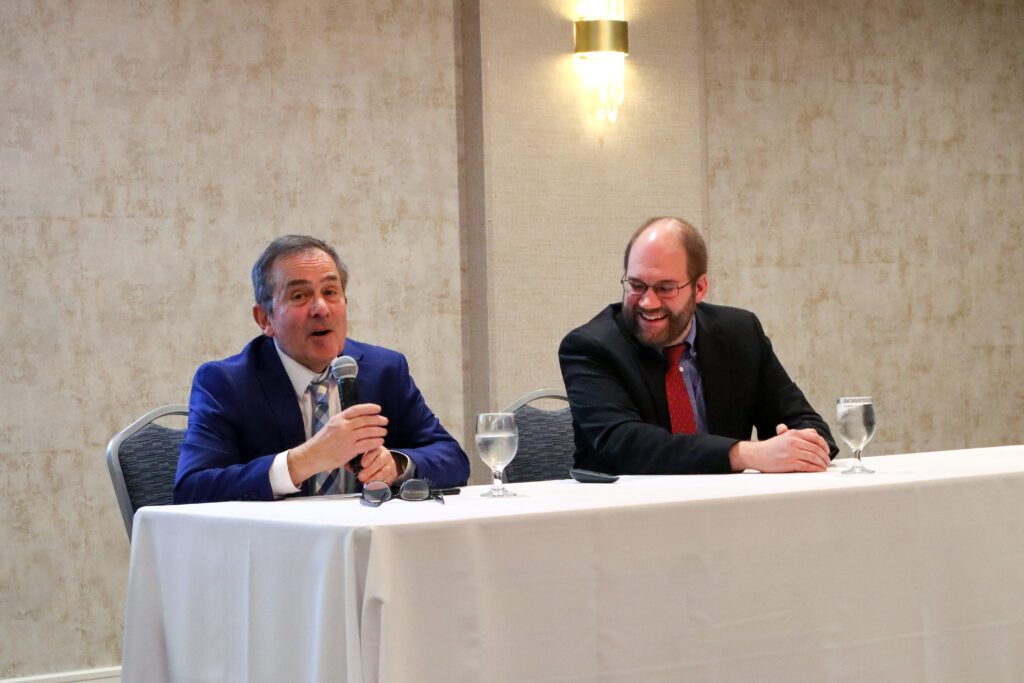
Last month, the Chamber hosted its annual Economic Outlook forum at the DoubleTree by Hilton, generously sponsored by Eversource Energy. Presenters Brian Gottlob and Phil Sletten delivered a cautiously optimistic forecast for the national and state economies for the upcoming year. While trends and economic indicators have shown encouraging momentum in the past year, the labor market is still stalling and household budgets remain under significant strain.
Gottlob, Director of the NH Department of Employment Security’s Economic and Labor Market Information Bureau, identified a key issue in the national economy as being hiring weakness. “I characterize what’s happening right now as a no hire, no fire economy,” he explained, pointing to low layoffs and low unemployment claims despite job growth remaining limited. Looking ahead, he expects the broader economy to strengthen somewhat in 2026, but warned that job gains may stay sluggish, due in part to a lack of confidence among businesses, particularly smaller employers. He described uneven workforce trends, calling it an “E-shaped economy” in which small businesses have faced sharper job losses and tougher adjustment pressures.

“What’s most difficult in the current situation for smaller business is to accommodate either higher wages [or] higher prices; they can’t adjust supply chains to deal with tariff issues.”
This lack of confidence from both a business and consumer perspective was a central theme throughout both speakers’ presentations. Gottlob noted that consumers “are not feeling very good,” citing sentiment readings that he said are “lower than it was during the worst of the pandemic.” In his view, one culprit is challenges with affordability, pointing to broad price increases and the mounting costs of living expenses. Gottlob added that while spending has continued, it is increasingly concentrated among higher-income households, which could make the expansion more vulnerable if asset markets wobble. He also demonstrated skepticism for key inflation data, arguing the reported 2.7% reading was understated and likely closer to 3%, attributing the discrepancies to disrupted data collection due to circumstances such as the national government shutdown in the fall of 2025.
Sletten, representing the New Hampshire Fiscal Policy Institute, reinforced the same synopsis with a focus on state-level conditions and policy. New Hampshire’s broader economy, he described, was feeling the same pressures that are seen at the national level, but with a unique set of regional challenges. He highlighted a lagging labor force characterized by long-term demographic headwinds—an aging population and reliance on migration for growth—and underscored how affordability challenges may deter potential new residents/families and young workers from moving to the state.

“[The problem isn’t] about attractiveness, it’s just “is it worthwhile?” Does the math work for people to live here? And even if it does, what does that mean for their spending power on the ground?”
New Hampshire’s budget has also faced new boons and challenges as a result of policy shifts at the state and national level, with Sletten emphasizing growing fiscal pressure and limited room for new initiatives. He noted that although state revenues have demonstrated improvement, they haven’t yet shown clear, reliable surpluses. At the same time, new federal limits on programs such as Medicaid and SNAP mean the state will likely need to seek new funding sources to maintain current service levels and will receive less federal money that, in his view, otherwise acts as an economic stimulus.
To illustrate the squeeze, Sletten presented an affordability analysis that showed inflation-adjusted annual costs of common expenditures. These were up across the board, with the largest increases including mortgage payments and child care. These costs, he said, have risen much faster than the median household income, leading to a negative net savings as opposed to positive savings in previous decades. As he explained in his takeaway, even if 2026 brings more certainty for business decisions, these persisting high costs may continue to constrain household spending power and the state’s economic momentum.
After the presentations, a Q&A session was held; attendees asked topical questions about the housing market, business favorability, and skewed data reporting due to the increase in nontraditional employment avenues such as gig jobs. Gottlob and Sletten affirmed that New Hampshire is still a desirable place to conduct business, especially in the context of the entire Northeast region, and expressed optimism for the forecast of the economy moving forward.
Watch the full recording of this event, thanks to our friends at ConcordTV. We would like to extend our thanks to Eversource for sponsoring this discussion.
Use the button below to access slides from the presentation.
Incorporated in 1919, New Hampshire’s state capital chamber of commerce—the Greater Concord Chamber of Commerce—develops economic opportunities, strengthens the business climate, and enhances quality of life in the Capital region. As largest chamber in the state, it is deeply invested in the local community and dedicated to shaping competitive economic development strategy, advocating for policies and projects that benefit the region, and promoting Concord as a culturally vibrant visitor destination. For more information, please visit concordnhchamber.com.